
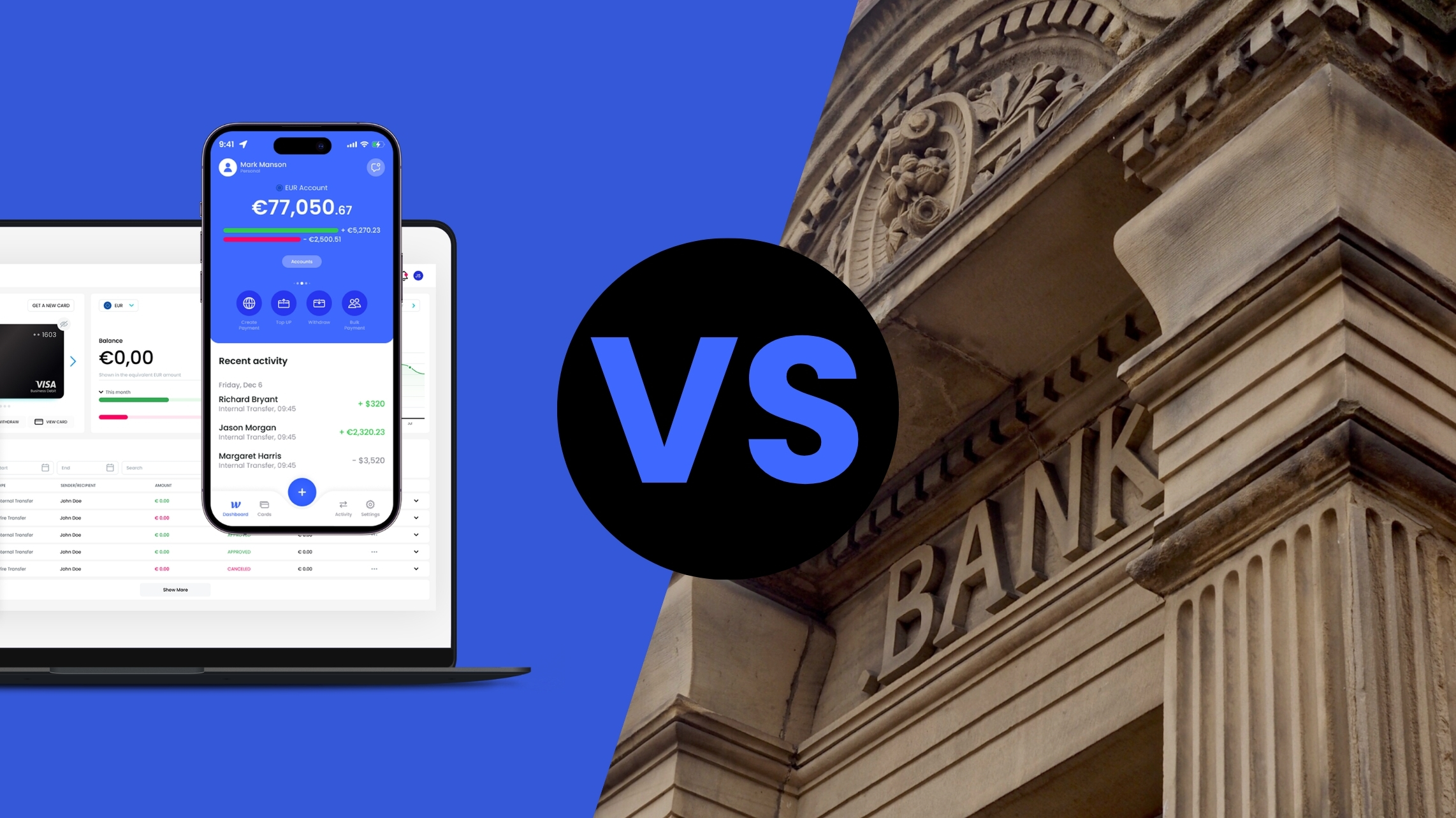
EMI vs Bank: Which Should Your Business Use?

You do not usually compare an EMI vs bank until something slows you down. Maybe an international payment takes too long. Maybe a supplier asks for account details you do not have, or the FX fee runs higher than expected. That is usually the moment businesses discover the electronic money institution. It is a regulated provider many of them have used for years without knowing its name.Both hold your money. Both give you an account and a way to send and receive. Underneath, they work differently. For a business moving money across countries, currencies and suppliers, the real question is not just where you hold the funds. It’s how easily they move.
The quick verdict
An EMI and a bank both hold funds and move payments. A bank can lend your deposits out and offers deposit-guarantee protection. An EMI cannot lend client funds and must keep them safeguarded and separate. For international business payments, a multi-currency EMI account often fits better. For credit and lending, you still need a bank. That’s the EMI vs bank choice, stripped to its core.
| Topic | Traditional bank | EMI |
|---|---|---|
| Main use | Deposits, lending, banking | Payments, e-money, cross-border money movement |
| Lending | Yes | No |
| Fund protection | Deposit guarantee scheme | Safeguarding |
| Onboarding speed | Slower, can take weeks | Digital, typically a few days |
| Digital-first approach | Not always | Yes, by design |
| International transfers | Often slower, higher cost, single-currency focus | Usually faster and cheaper, multi-currency by default |
| Physical branch access | Yes | Typically no |
| Best for | Credit and large balances | Payments and international activity |
What an EMI actually is
An EMI, or electronic money institution, is a regulated provider authorised to issue electronic money and offer payment services. That includes business accounts, dedicated IBANs, SEPA and SWIFT payments, and cards. Under the EU’s E-Money Directive (2009/110/EC), it covers most of what a business account needs. There is one firm limit: it cannot lend your money out.
Banks work differently. Your deposit goes onto the bank’s balance sheet. The bank then lends much of it back out as mortgages, overdrafts and business loans. An EMI cannot do that, and it cannot take deposits in the banking sense. It receives your funds in exchange for e-money and handles them under strict safeguarding rules.
That one restriction explains most of the practical differences behind every EMI vs bank comparison you’ll read.
Benefits of using an EMI
Faster onboarding. Digital-first verification means an account can usually open within a few business days once all documents are in. At a bank, the same process can take weeks.
Multi-currency by default. Hold what you’re paid in and convert on your own schedule, instead of a forced conversion the moment money lands.
A business IBAN that works internationally. Clients can pay you like a local, even when you’re trading across several countries.
Cards issued fast. Virtual and physical cards, often ready within minutes, with spend tracking built in from day one.
Transparent pricing on international transfers. Banks commonly build a 2-5% markup into the exchange rate on cross-border payments, even when the transfer itself is advertised as free. EMIs are generally built to show rates closer to the mid-market rate.
Smart tools for financial management. Dashboards, integrations, automation, and role-based team access come built into the platform rather than sold as add-ons. The whole system improves on a faster release cycle than a bank’s core banking software, which is often decades old.
Benefits of using a bank
Access to credit and lending. Overdrafts, credit lines, and business loans are all available. An EMI cannot legally offer any of them, since only a bank can lend against deposits.
Fast, guaranteed repayment up to a set limit. A deposit guarantee scheme pays out automatically, up to €100,000 per depositor. There’s no need to wait for an insolvency process to run its course.
Physical branches. For businesses that occasionally need in-person service, handle cash directly, or simply want a face-to-face conversation, a branch network is a real advantage. An EMI does not offer one.
Institutional history and scale. Decades of operation and established relationships with other financial institutions come with the territory. For some businesses, a full banking licence and a long-standing name carry real reassurance.
How your money is protected: safeguarding vs deposit guarantee
This is the part worth getting right, because the two models protect you in different ways.
A bank is covered by a deposit guarantee scheme. Under EU Directive 2014/49/EU, it protects eligible deposits up to €100,000 per depositor, per bank. An industry-funded scheme repays you automatically if the bank fails, without waiting for an insolvency process to run its course.
An EMI protects your money differently, and in one important way more completely. The E-Money Directive requires it to safeguard client funds from the moment it receives them: keep them separate from the company’s own money, hold them at a credit institution or in low-risk assets, and never lend them out. Safeguarded funds are legally ring-fenced for clients, ahead of any other creditor. There is no cap on how much is protected this way, unlike the deposit guarantee’s €100,000 limit. Regulators have continued to strengthen the audits and reporting behind this protection in recent years.
Neither model is simply safer than the other. They are different protections for different jobs. A bank spreads risk through lending and backs deposits with a guarantee scheme capped at €100,000. An EMI keeps client money out of its own business entirely, with no cap on the amount protected.
EMI vs Bank: When Should Your Business Use Each?
Think about what your money actually does all day. That’s the real basis for any EMI vs bank decision, not the label on the account.
Choose an EMI if:
- Payments, not credit, are your day-to-day: invoicing clients abroad, collecting in several currencies, paying suppliers across borders
- You want a business account open in days, not weeks
- You or your directors live in a different European country from where the business is registered
- You need a business IBAN your clients can pay like a local
Choose a bank if:
- Borrowing is central to how you operate: credit lines, overdrafts, business loans
- You’re parking large cash reserves and want the speed and certainty of an automatic deposit-guarantee payout
- Lending needs are frequent enough that a relationship with a lender matters more than payment speed
Use both if: many businesses do. Run day-to-day payments and multi-currency collection through an EMI, and keep a bank relationship specifically for the moments you need to borrow.
One more scenario changes the calculation: distance. Many European banks want a resident director, a local address, or an in-person visit, especially once the business is foreign-owned. If your company is incorporated in one European country but you live somewhere else, and you need a European IBAN to trade with EU clients, that local-presence requirement can rule a bank out before you even apply.
Beyond the category: what to check for your specific business
Choosing EMI over bank, or the reverse, only answers half the EMI vs bank question. The other half is which specific provider will actually work for your business.
| Criteria | Traditional bank | EMI |
|---|---|---|
| Cards | Some larger banks now offer true virtual cards; many still only support a digital copy of your physical card, sharing the same card number | Virtual cards with their own separate card details, usually issued instantly |
| Dedicated account manager | Common practice, but usually reserved for the largest corporate clients | Varies by provider: some offer one by default, others run self-service only |
| Business acceptance | Tends toward blanket exclusion of entire industries considered high-risk, regardless of the individual business | Generally assesses risk per business rather than excluding whole industries outright, though each provider has its own restricted list |
How to make your EMI vs Bank decision
Whichever type of provider you’re leaning toward, check:
- The provider’s licence number against the national regulator’s public register, not just their own website.
- Fees for your actual payment corridors and currencies, not the advertised headline rate: banks in particular are known for burying a 2-5% markup inside an exchange rate advertised as “no fee.”
- Exactly when they assign a dedicated account manager, if at all, and what triggers it.
- Whether your business’s risk profile is one they typically accept, or whether they’ve historically excluded your entire industry.
- Whether your directors’ or owners’ country of residence fits their onboarding requirements.
- Whether you need this account alongside a bank rather than instead of one; lending needs still require a bank.
If what you need is multi-currency accounts, a platform that’s simple to run day-to-day, and dedicated support from the moment you apply, Wittix is built around exactly that combination. It’s an Electronic Money Institution licensed and supervised by the Bank of Lithuania, listed on the national regulator’s public register.
Frequently Asked Questions
No. EMIs do not participate in deposit guarantee schemes and do not offer deposit insurance. They protect funds through safeguarding instead: client money is kept separate from the EMI’s own funds, held at a credit institution or in low-risk assets, and never lent out. A bank offers a deposit guarantee scheme and lends deposits out; an EMI cannot lend client funds. Different models, different protections, neither one simply “safer.”Is my money guaranteed with an EMI the way it is with a bank?
No. Lending is a banking activity, and an EMI cannot extend credit from client funds. If you need borrowing facilities, that is a reason to keep a bank relationship.Can an EMI give me a loan or an overdraft?
It depends on the provider. Many banks reserve a named account manager for their largest corporate clients, and plenty of EMIs run on self-service support alone. A smaller number, Wittix included, assign a dedicated account manager the moment a business becomes a lead, before the application process starts, not just once you’re a large account.Do EMIs offer the same account support as a bank?
If all required documents and information are provided, a Wittix business account can typically be opened within 1-3 business days.How fast can I open a Wittix account?
Yes, and many do. A common setup keeps a bank for loans, overdrafts and large reserves, and runs everyday payments, payroll, supplier payments and currency conversion through an EMI account.Can a business use both a bank and an EMI?
Open a multi-currency business account
If your business works across borders, open a Wittix multi-currency business account. Manage dedicated IBANs, SEPA and SWIFT payments, and cards from one place, with a personal support specialist who knows cross-border operations. Get started below.
About Wittix
Wittix, UAB is an Electronic Money Institution licensed and regulated by the Bank of Lithuania (EMI Licence No. 48), operating under the European Central Bank’s legal framework. We offer fully digital financial services for individuals and businesses, including multi-currency European accounts, SEPA and international payments, cards, and expense tools. Whether you’re scaling online or managing a more traditional operation, local or global, Wittix provides a platform that’s easy to use and a team that delivers real, personal support.
Learn more, speak with our team, or open an account at wittix.com.
Sources: EU E-Money Directive 2009/110/EC (safeguarding and activity rules); EU Deposit Guarantee Schemes Directive 2014/49/EU (€100,000 coverage level); European Banking Authority, Deposit Guarantee Schemes data; UK FCA safeguarding shortfall analysis and 2025 safeguarding rules overhaul.
This article is for informational purposes only. Information accurate as of 10 July, 2026. This article is not intended to constitute financial advice.